A Season

And I would add to these biblical words:

To everything a season to brew and for every tea, a purposeful water temperature and a time for steeping.

Season of Steeping – Time

As a general rule, the less the tea is processed, (see 3/20/2019 post) the less time the tea should steep for Western-style brewing.  But because there are so many ways to process tea, you should following the suggestions of the tea producer or ultimately rely on YOUR OWN TASTE!

Here is a chart to guide you in beginning your steep times. The more you brew teas, the more you will find the perfect steep time for each tea.

A Purposeful Water Temperature

To brew the perfect cup of tea, the water temperature should not be neglected. If it is not hot enough, the leaves may not fully open to release their flavor. Too hot, and some teas will be “scorched” which will alter the taste. It is also prudent to use filtered or spring water for the optimal steeping water for your tea.

This water temperature chart is a general guideline. Again, use the tea producer’s recommendation or your own individual taste.

Of course, you have to be able to see the water heating to gage its temperature

Or – you could use a thermometer

Or – you could use a glass, self-heating teakettle. This is the way I like to go and this teakettle has everything I wanted

  1. See through glass
  2. Heats 16-60 oz. of water very quickly
  3. Water temperature can be selected from 140 to boiling – no need for thermometer!
  4. It signals with a beep when the water is the correct temperature
  5. An added bonus is the base lights up with a different color for each water temperature! It is both practical and pretty and I use it every day.

For your “Season of Tea” may you find that perfect time and purpose for every cup you sip.

all photos and charts by Robin Kolterman

Coconut Oolong

Delft Blue teapot made in Holland with tea light warmer

Another of my favorite oolongs is Coconut Oolong from The London Tea Room in St Louis so this is the tea we will be enjoying this morning. Oolongs can vary in color from light gold to deep brown and orange depending on the level of oxidation. This oxidation level, along with the shape of the leaves can affect the steeping time and the way the tea is brewed. (See yesterday’s post on processing oolong teas).

There are two different ways to brew an oolong, the Asian or the Western style. The Asian- style uses a small, under 10 oz, unglazed teapot or a fully glazed Gaiwan (a lidded bowl without handles and a saucer). The biggest difference however, is the greater amount of tea leaf used to a smaller amount of water. Brewing time is shorter, but multiple steepings are made with the same leaves, changing the character of the tea each time.

For the Western-style of brewing, it is recommended to use 2 teaspoons of half balled- style tea per 6 oz of water or 1-2 Tablespoons of strip-style or leaf-style tea. (See yesterday’s post for a picture of balled or strip-style leaves).

The water temperature should be 180 to 200 degrees F. Since there are both light and dark oolongs, a general rule is, the darker the leaf, the hotter the water. Filtered or spring water is recommended

Rinse the tea: traditionally, oolong teas are rinsed first with hot water to begin opening up the leaves. To do this, add just enough water to cover the tea leaves and immediately discard the liquid. Then add additional hot water for the first steeping.

Steeping: Western-style steeping can be for 3-5 minutes depending on the leaf style. The tighter the leaf, the longer the steeping time. It is also a personal choice in taste. Start with a one minute steeping and taste every 30 seconds. However, do not let the leaves STEW in the hot water. You will not get a stronger tasting tea by steeping longer. The only way to get a stronger tea is to use more tea leaves. Western-style steeping may be able to get a second re-steeping but not the multiple times as with Asian-style preparation.

If you are just starting out with on Oolong tea, try the Western-style of brewing first then venture on to the Asian-style.

Magnolia Oolong

Bees at the hive entrance

Today is the first day of spring and my bees are busy buzzing in the maple trees bringing in the first of the pollen for the year. With the cold weather staying so long this year, the trees are blooming a month later than last year!!

Today I have chosen Magnolia Oolong tea in honor of spring and the flowers to come. This tea has a slight Jasmine, floral taste which is very pleasant. Oolong teas have become some of my favorite teas to sip. I’ve come to this conclusion after several times drinking a tea and thinking, wow; this is really good, then realizing it is an Oolong.

As you know, all true teas come from the same plant, Camellia sinensis; it is the different processing steps of the tealeaf that make the different types of tea. Oolong is the most popular spelling in the west but it is also known as wulong, which means “black dragon.” Oolongs are grown primarily in China and Taiwan. A simple way to classify an Oolong is that its oxidation level is between a green and black tea but even within that gradient, there are many different, minute levels of processing.

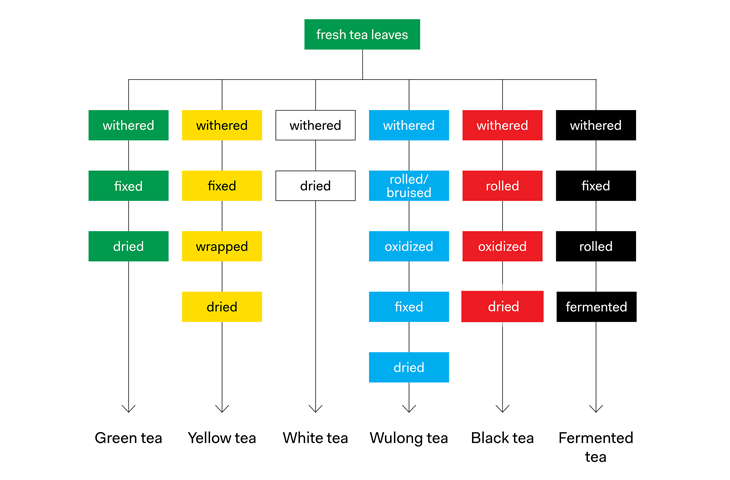
I like this chart to help show the (minimal) processing steps of different teas. It is from Tony Gebely at https://www.worldoftea.org/tea-processing-chart/

If you are interested, here are the processing steps for an Oolong. Plucking: Three to five leaves of the tea plant are hand plucked, then the leaves are withered in the sun or in diffused light outdoors. A distinct step in the process of Oolongs is the bruising or rolling of the leaves to break the cell walls and initiate oxidation. This is done in a variety of ways depending on the intended final outcome. The leaves can be tumbled, shaken or even lightly rolled. The leaves are then left to wither, usually indoors this time, until the preferred amount of oxidation occurs. Oolongs are referred to as semi-oxidized teas but the greenest Oolongs are oxidized to around 5-10%  with the darker ones oxidized 80-90% which is oxidized almost as much as black teas. This is important to know when brewing an Oolong, which I will talk about another time.


When the proper oxidation level is reached, the leaves are fixed by hot air in heated tumblers to halt the oxidation. Now the leaves are shaped, traditionally, in two different shapes: half-ball or strip shape. (Shown in left picture).

The half-ball style is formed by wrapping the leaves in a cloth and kneading them sometimes for several hours. Most commercial applications use a machine to do the kneading but there are still some small-scale artisans who still accomplish this task by hand (or their feet).

For strip shaped Oolongs, The leaves are twisted length-wise rather than rolled into a ball. The amount of pressure exerted on the leaves is carefully monitored so the leaves are not ripped apart. This process is done by hand or machine but without the use of cloth.

The final step for the leaves is drying and roasting. As the leaves are rolled or kneaded, they clump together into a large mass. This is broken apart so the leaves can be easily dried. This is done in large commercial ovens or for smaller artisan production, a basket over hot coals slowly dries the leaves. This is called firing or first drying. Oolongs will usually go through a second drying also known as roasting. This roasting mellows the tea’s flavor and adds to the complexity of taste.  

Matcha St Patrick’s Day

St. Patrick’s Day “tea” is a little different than usual. We are enjoying chocolate chip mint ice cream with a bit of matcha decoration on top. Matcha is very popular these days for its many health benefits but what is Matcha?

Matcha is a true tea from the Camilla sinensis plant that is shade-grown and processed differently than traditional green teas. With the sun exposure highly controlled, the chlorophyll content increases giving it the rich green color. The shade also alters the chemical make-up and flavor of the plant. The leaves for matcha are only hand harvested in spring from the bud and first three leaves. This short harvest window is one of the reasons it can be so expensive.

Shortly after the leaves are picked, they are heated briefly with stem to halt the oxidation process. After being  laid flat to dry, the leaves are stone ground to produce a smooth green tea powder. It is this powder that is whisked until frothy into hot water, not steep as with traditional tea. Since the whole leaf is consumed with each sip of tea, the caffeine content of matcha (25 to 70 mg) is higher than even black tea (14-61 mg) but less than coffee (85-200 mg).

There are two grades of matcha, ceremonial and culinary. The ceremonial matcha is very expensive and is used in the traditional Japanese tea ceremony. The culinary type is less expensive but still higher priced than most other teas. It has a much more vegetal palate but its bold taste goes well in foods and other beverages like lattes. HAPPY ST PATRICK’S DAY!

Queen of Hearts

Queen of Hearts

This morning we are enjoying “Queen of Hearts” from my favorite tea shop, The London Tea Room in St. Louis, Mo. It is a blended, flavored back tea that is very pleasant in scent and taste. It was originally blended to give tribute to the Lewis Carroll novels. This tea is reminiscent of the shops famous, “Naughty Vicar”  tea but a bit smoother. To my palate, it has a floral, perhaps rose note. The description for the tea says “blackcurrant” but I am unfamiliar with that taste so I will go with subtle rose.

My red, cast iron, enameled teapot is one of my favorite. It is the perfect size for 3-4 cups of tea and is my go to pot for everyday tea. Note the tea cozy in the picture. I prefer keeping my tea warm in the pot while I sip instead of using a large mug thus the cozies are very practical. Two of the cozies I made for my smaller pots and the larger one I made from beautiful quilting fabric.

This little cup and saucer actually are not a matched set. I found the cup at a garage sale (Colclough bone china made in England) and remembered I had seen a saucer without cup at another sale so I returned to find it to make a set.

Assam: Camellia sinensis variety assamica

What is Assam tea? The name Assam can refer to a variety of tea, where it is grown or how it is crafted. In its broadest sense, the name Assam refers to a variety of the Camellia sinensis tea plant that has a broader leaf than the sinensis variety. This native plant of India was first discovered in northeastern corner of the Indian subcontinent, in the state of Assam. Thus, the British named the tea for this region, which has become one of the most prolific tea producing areas in the world due to the long growing season and naturally suited climate. The assamica variety is grown in India and also Sri Lanka and other regions close to the equator but the name Assam can only be used for tea grown in Assam, India.

Assam tea is not only sipped as a single leaf tea type but it is more often used in many blended black teas such as in English and Irish breakfast blends. The flavor profile of Assam is said to be malty with a rich body and vibrant color. Its moderate caffeine content makes it a, non-jolting, morning drink. It easily mingles with milk and a sweetener if desired.

My Bee skep teapot collection includes a single serve cup and teapot along with a sugar and milk pitcher and a large cookie jar. Although I do use them occasionally, it is really more of a novelty set.

Change of Seasons

Christmas tea tray

Spring is almost here! My bees were flying yesterday since we finally receive a warm sunny day. However, we’re all back inside today with the rain. While making my tea this morning, I noticed that I had not changed my tea tray panel. I use this little tea tray whenever I want to take my pot, teacup and other tea paraphernalia to my bedroom or out to my “Summer Sweet Spot” (more on that later). To make this tray, I started with an unfinished, purchased one from Hobby Lobby. I felt it was a little flimsy, so I reinforced it with a piece of 1/4 inch plywood that just fit up into the recess on the bottom of the tray. I finished all sides of the tray with stain and varnish. For the decorative panels, I fused two different fabrics together with fusible webbing. I made two of these panels giving me four different looks. I then had a piece of 1/8 inch clear glass cut to fit the top inside of the tray. Both fabric panels fit under the glass and when I want to change the look, I simply pop the glass out and turn the panel I want to present to the top. I have a different one for each season of the year. This was a fun project to complete and is very practical and useful for me.

summer panel
Bottom of tray and two panels & glass

Turmeric & Ginger

Monday mornings I try to start the week with a healthy tisane of Turmeric and Ginger. This is from my favorite tea shop in St Louis, Mo, The London Tea Room. Turmeric is the spice that gives curry its yellow color. The compounds that give turmeric its medicinal properties are called curcuminoids, the most important one being curcumin. Curcumin is a natural anti-inflammatory and dramatically increases the antioxidant capacity of the body. It is said to boost brain function and can be used to prevent and treat Alzheimer’s disease. It can lower your risk of heart disease, help prevent cancer and relieve arthritis and depression. With this impressive list of health benefits, I should be drinking it EVERY DAY!

Ginger is a natural to go along with turmeric. It is also an anti-inflammatory and has its only list of health benefits including digestion aid.

This tisane from The London Tea Room contains turmeric, ginger, lemon, curry, mustard, and honey. I always add some ground black pepper because it contains piperine, which helps to absorb the curcumin into the blood stream. Otherwise, it just passes through the body.

I can’t say this is one of my favorite tisanes. I have found that I prefer a milk based recipe called Pot-of-Gold, which would be a perfect drink to serve for a St. Patrick’s Day celebration coming up!  The recipe that follows is for a dry spice mixture but today I made the same recipe with fresh ground and grated ingredients and a turmeric extract. Turmeric powder only contains about 3% by weight of curcumin so it would be very difficult to get enough curcumin through diet alone. The extract gives 1000 mg. I also used fresh ginger root and grated Ceylon cinnamon, which may have better health benefits than the common cassia cinnamon. 

Pot-of-Gold

Pot-of-Gold

¾ tsp t turmeric powder or (1 T fresh grated root or use 1 serving of extract)

¼ tsp ginger powder  or (1 tsp fresh grated ginger root)

1/8 tsp cinnamon or (1/8 tsp. grated Ceylon cinnamon)

1/32 tsp cloves

1/32 tsp ground pepper

1 tsp honey or to taste

1 cup milk

Add spices to milk and heat in microwave until steaming or on stove stirring constantly. Add honey and turmeric extract if using. Strain milk if you used fresh ingredients. Froth with a foamer or whisk. Serve hot.

Catnip Night Cap

On my recent visit to the Spice Merchant in Wichita, Ks., I acquired a new tea, Catnip. Actually I should not say tea but tisane since all true teas come from the same plant, Camellia sinensis. Catnip is from the mint family. It has a history of being used to treat a number of ailments including insomnia, anxiety, headaches, nervousness, anxiety, cramping and gas. Even though there is not much scientific research on its medicinal uses, it has much anecdotal evidence for the treatment of arthritis, coughs, fevers and viruses.

I am mainly interested in its relaxation and sedative effects for a bedtime tea. Like valerian, a commonly used herbal sedative, it contains nepetalactone. However, since it is also a diuretic, I will be sure not to drink too much before bedtime!

To brew, I used 1 T of the dried leaves with boiling water and steeped for 10 plus minutes as is usually done with herbal tisanes. The flavor is not one of my favorites, being somewhat “woodsy” tasting. I added a bit of lemon juice and honey and it is pleasant enough. My kitty certainly enjoyed his cup of tea.

Rompope

This is one of my favorite flavored black teas from the Spice Merchant in Wichita, Kansas. As you will notice, I usually use loose-leaf tea, which I prefer, but because this tealeaf is so fine, I often put it into sealable tea bags. My mini hair straightener works perfect for sealing the bags.

The word Rompope is derived from rompon, which is the Spanish version of eggnog that came to Mexico and utilizes rum as a main ingredient along with eggs, milk and vanilla. This tea version made with black tea, natural and artificial flavors, is full bodied with a hint of creaminess. It brews quickly due to its fine leaf. This is one tea that I do like to add a little milk and sometimes a drop of honey.

This cute little tea pot is a nesting, two-piece set which brews enough for one.